
Keep a fake candidate out of your payroll
Catch synthetic and fraudulent candidates in remote interviews before they reach payroll and your systems, including the operators who pass screens to get inside.
From signals to one action your team can take.
- UnverifiedIdentityName on the application does not match the identity behind the email and phone records
- SyntheticVideo and voiceFace-swap and voice-clone artifacts present during the screen
- Repeat actorCross-loopSame backing actor appears across two candidate personas
- EvasionBehaviorResists steps that would confirm identity or reveal a second person
Flag the interview. Recruiting pauses the loop before an offer is extended.
Where Diopter sits in your hiring process
Detection on its own is a point in time. These are the stages your team already runs, and what Diopter does at each one.
Verify the candidate before anyone joins
Identity and social checks run against the application ahead of the screen, so the recruiter walks in already knowing whether the person booked is the person applying.
- Identity match: the name on the application against the identity behind the candidate's email and phone records
- Social and footprint checks: work history and profile consistency, and whether the address has any prior correspondence with your org
- Results land before the call starts, not in a report afterwards
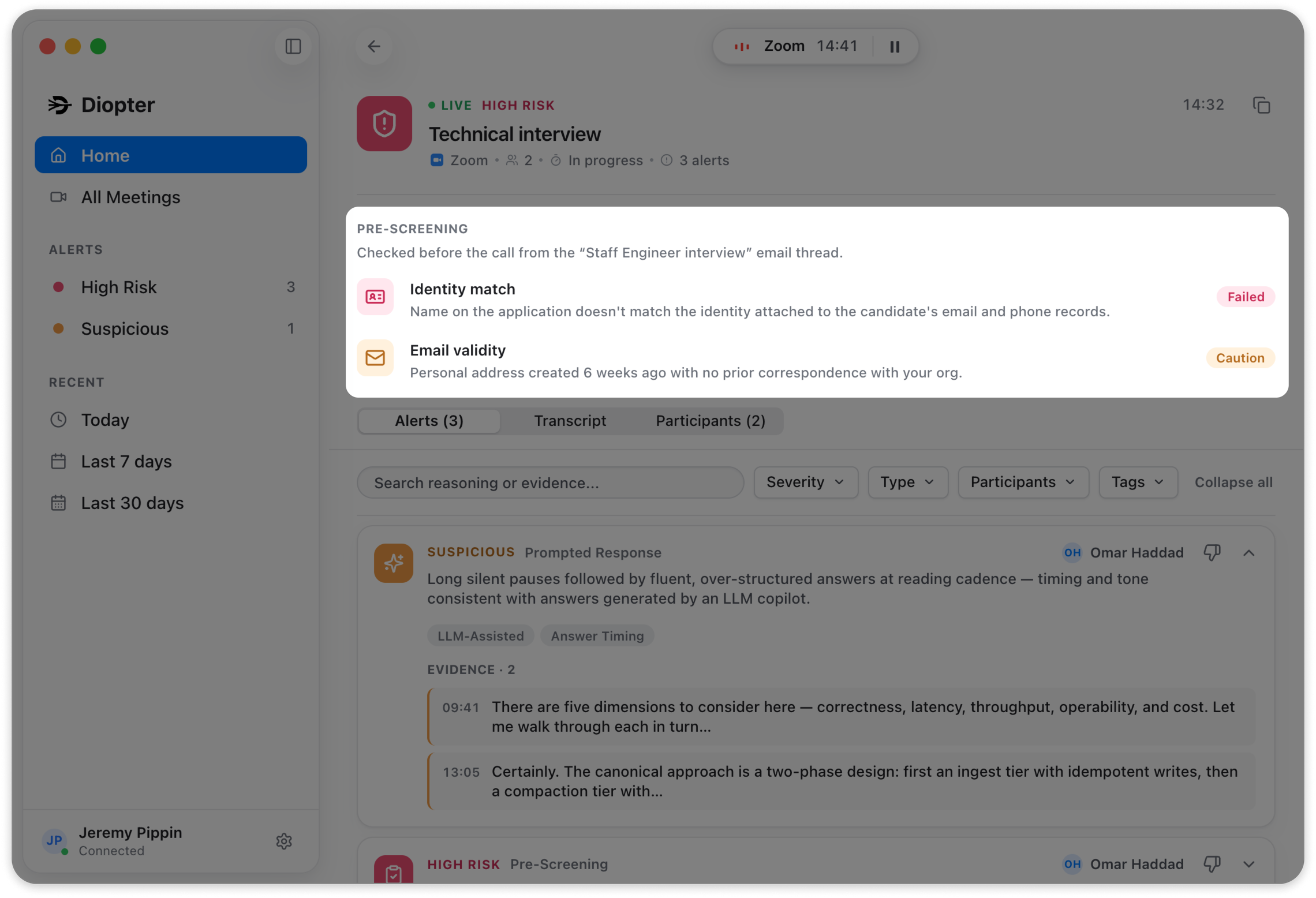
Every verdict, and the transcript behind it, flows back to the candidate record in your ATS, so the finding lives with the requisition instead of in a separate tool. Slack alerts are available for the flags your team wants to see immediately.
What Diopter looks for
Synthetic video and voice in interviews
Score the candidate's video and audio for deepfake and cloning indicators during the screen.
Applicant identity verification
Check the person applying against trusted identity signals and verification tools, confirming the candidate is who they claim before access and payroll.
Cross-loop consistency
Surface the same backing actor or persona reused across interview rounds.
Behavioral signals
Track the evasion and coaching patterns common to fraudulent interviews.
Where recruiting fraud shows up
- 01
Synthetic candidates
Deepfake faces and altered voices used to pass remote interviews, including state-sponsored operators looking for a foothold.
- 02
Proxy and backing actors
A different person feeding answers or appearing across multiple candidate personas.
- 03
AI-assisted and coached answers
A candidate leans on an AI tool or a hidden coach to answer live, producing polished responses that do not reflect their own knowledge or experience.
How a candidate fraud attack unfolds
These attacks move through a recognizable sequence. Diopter scores that sequence while the call is still in progress.
A polished persona
A candidate presents strong credentials and a convincing video presence for a sensitive role.
Competing offers
Pressure to move fast discourages extra rounds or deeper verification.
Keep it remote
The candidate avoids steps that would confirm identity or surface a second person.
A backing actor steps in
A proxy feeds answers, or the same operator appears across multiple personas.
An offer and access
The hire reaches payroll and systems before the fraud is caught.
Most tools check the interview. The fraud runs your whole funnel.
A fake candidate is not a bad thirty minutes on Zoom. It is a flood of near-identical applications in the first days of a posting, a fabricated work history, an identity that does not belong to the person on camera, and access to your systems once the offer lands. Teams tell us their real control today is making people come in person, which does not scale and does nothing for the screening rounds before it. Diopter verifies the candidate before the call, scores the call itself, and writes the verdict back to the record your recruiters already work from.
A synthetic candidate can pass one screen. The identity behind the application, the same backing actor across rounds, and the evasion under questioning are the tells a single screen misses.
Verdicts land where your team already works
Interview verdicts, transcripts, and notes syncing straight to the candidate record in your ATS, so the finding lives with the requisition instead of in a separate tool. Direct ATS integrations are in development.




%20--%3e%3csvg%20version='1.0'%20id='Layer_1'%20xmlns='http://www.w3.org/2000/svg'%20xmlns:xlink='http://www.w3.org/1999/xlink'%20x='0px'%20y='0px'%20viewBox='0%200%20130.1%2039.8'%20style='enable-background:new%200%200%20130.1%2039.8;'%20xml:space='preserve'%3e%3cstyle%20type='text/css'%3e%20.st0{fill:%2348A8AF;}%20.st1{fill:%23010101;}%20%3c/style%3e%3cg%3e%3cg%3e%3cg%3e%3ccircle%20class='st0'%20cx='5.3'%20cy='5.3'%20r='5'/%3e%3cg%3e%3cpath%20class='st1'%20d='M25.7,18c2.3,0,3.7,1.2,4.4,3.2h9c-1.4-6.6-6.3-10.4-13.2-10.4C17.7,10.8,12,16.3,12,25%20c0,8.7,5.7,14.2,13.8,14.2c6.9,0,11.8-4,13.2-10.4h-9c-0.7,2-2.1,3.2-4.4,3.2c-3,0-5.1-2.4-5.1-7S22.7,18,25.7,18z'/%3e%3cpath%20class='st1'%20d='M107.9,19.2c0-1.3,1.1-2.1,3.1-2.1c2.4,0,3.8,1.2,4.1,3.1h7.8c-0.5-5.4-4.5-9.4-11.6-9.4%20c-7.2,0-11.2,3.9-11.2,8.5c0,10.1,15,6.9,15,11.4c0,1.2-1.1,2.2-3.3,2.2c-2.3,0-4.1-1.3-4.2-3.2h-8.4c0.4,5.3,5.3,9.4,12.7,9.4%20c6.9,0,11.2-3.6,11.2-8.4C122.9,20.5,107.9,23.6,107.9,19.2z'/%3e%3cpath%20class='st1'%20d='M5.3,12.8c-1.6,0-3-0.5-4.2-1.3v27.3h8.5V11.5C8.3,12.3,6.9,12.8,5.3,12.8z'/%3e%3crect%20x='40.6'%20y='11.2'%20class='st1'%20width='8.5'%20height='27.6'/%3e%3cpath%20class='st1'%20d='M86.4,10.9c-4,0-7.5,2.2-9.3,5.1c-1.9-3.3-5.2-5.1-9.4-5.1c-3.6,0-6.4,1.5-8.1,3.8v-3.5h-8.5v27.6h8.5v-15%20c0-3.6,2.1-5.6,5.3-5.6s5.3,2,5.3,5.6v15h8.4v-15c0-3.6,2.1-5.6,5.3-5.6s5.3,2,5.3,5.6v15h8.4V22.6%20C97.7,15.2,93.3,10.9,86.4,10.9z'/%3e%3c/g%3e%3c/g%3e%3cg%3e%3cpath%20class='st1'%20d='M124,18c0-1.2,0.8-2.1,2.1-2.1c1.2,0,2,0.9,2,2.1c0,1.2-0.8,2.1-2,2.1C124.8,20.1,124,19.2,124,18z%20M124.3,18c0,1,0.7,1.8,1.7,1.8c1.1,0,1.8-0.8,1.8-1.8s-0.7-1.8-1.8-1.8C125,16.2,124.3,17,124.3,18z%20M126.3,18.2l0.7,1l-0.4,0%20l-0.7-1h-0.3v1h-0.3v-2.3h0.9c0.5,0,0.7,0.2,0.7,0.7C126.9,17.9,126.7,18.2,126.3,18.2z%20M125.6,17.2v0.7h0.6%20c0.3,0,0.4-0.1,0.4-0.4c0-0.3-0.2-0.4-0.4-0.4H125.6z'/%3e%3c/g%3e%3c/g%3e%3c/g%3e%3c/svg%3e)
Light to deploy, clear about what runs where.
Pilot in days, roll wider through MDM, and keep sensitive call media inside your perimeter.
- On-prem and hybrid deployments supported
- No caller-side install
- Bot or bot-free capture
- Configurable retention, including ZDR
- MDM rollout (Intune, Jamf)
- SOC 2 Type II in progress
Walk an attack arc with Diopter.
We will replay a real incident, show the signals Diopter scored, and map the verdict your team would act on. We will sign your NDA first if you want one.
What security and fraud teams ask first.
Yes. Those operations reuse personas and backing actors across rounds, which Diopter surfaces through cross-loop consistency.
Not yet. AI-assisted answer detection, reading response timing and answer structure for interview copilot use, is on the roadmap and not yet available. Today Diopter verifies the candidate's identity before the call and scores synthetic video and voice plus the conversation pattern during it.
Diopter reports a verdict with a confidence level and the evidence behind it, so a recruiter reviews rather than auto-rejects. Accent and region are not signals: the synthetic-media score looks for generation artifacts, not for how someone sounds or where they are from.
The interview is flagged with the signals behind it, so the team can verify before extending an offer or granting access.
No. Diopter scores the manipulation pattern, not isolated artifacts, so a normal call with real urgency does not trip it. Only the combination, an authority claim plus pressure plus an escalating ask, crosses the threshold. Your team sees fewer alerts with higher signal.
Diopter supports on-prem and hybrid deployments, with configurable retention including a zero-data-retention option. It runs with a meeting bot or bot-free, and needs no caller-side install. SOC 2 Type II is in progress.
Diopter works alongside the video and voice tools your team already uses, and rolls out through your existing MDM such as Intune or Jamf. There is no caller-side install and no change to how your team takes calls.
No. Every verdict carries a confidence level, not a flat flag, and if a call or file could not be fully checked, Diopter reports that rather than defaulting to a clean result. You can see this directly: every report from the Deepfake Detector shows the same confidence scoring behind Diopter's verdicts.
Research behind candidate fraud detection
All research →Deepfake Job Interviews: Inside the Rise of AI-Generated Fake Candidates
Deepfake job interviews are rising: 17% of hiring managers have interviewed AI-generated candidates. The red flags, the risks, and how to verify identity.
Synthetic Identity Fraud: Detection and Prevention
Synthetic identity fraud blends real and fake details into an identity that passes standard checks. How it unfolds, the signals, and how to prevent it.
What is a deepfake
Learn how deepfake technology enables fraud, impersonation, and identity attacks, and how security teams detect and prevent these emerging threats.